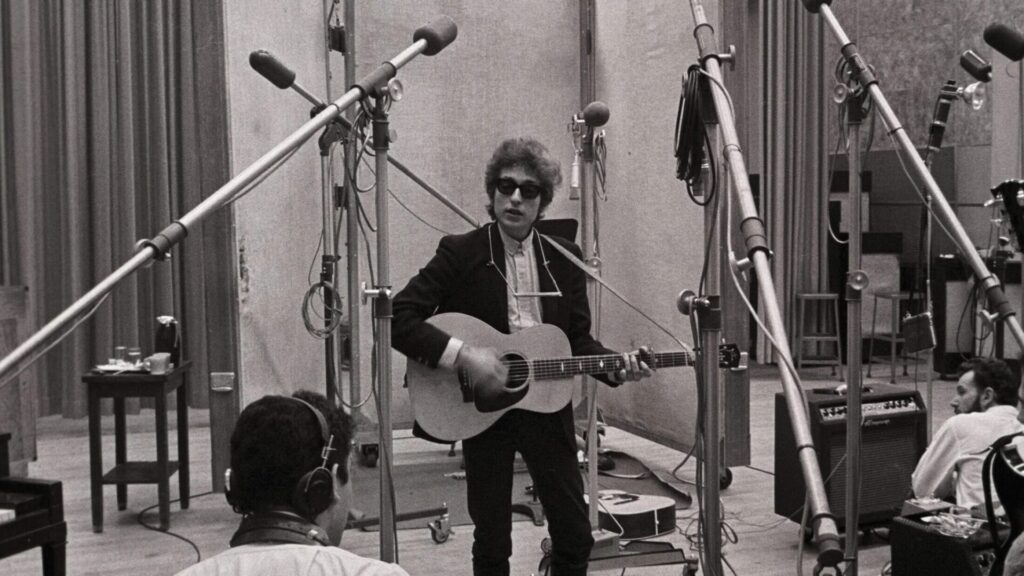
Bob Dylan did not simply bring poetry into popular music. He forced sound itself to learn a new language. Inside the recording studio, where words were expected to serve melody and melody was expected to behave, Dylan disrupted every assumption. His songs became places where literature, instinct, and performance collided, and the studio became the arena where that collision was captured in real time. The birth of modern songwriting did not happen on the page alone. It happened when Dylan’s words met microphones, musicians, and tape, and refused to behave the way anyone expected them to.
From Folk Verse to Recorded Truth
When Dylan arrived in New York in the early 1960s, the folk revival prized clarity and tradition. Songs were meant to be vessels for ideas, delivered cleanly and respectfully. Dylan absorbed that world quickly, but his ambitions were already stretching beyond it. His early studio recordings show a songwriter testing how far language could bend before it broke.
Songs like “Blowin’ in the Wind” sound deceptively simple, but their power lies in how the studio preserves restraint. Dylan’s voice is unadorned, almost plain, allowing the questions in the lyrics to echo rather than resolve. The recording does not dramatize the song. It trusts the words. In doing so, it signals a shift in songwriting, where ambiguity and moral tension could exist without explanation.
The Studio as a Literary Laboratory
Dylan’s writing often began in solitude, but the studio transformed those private poems into public statements. Unlike traditional pop songwriters, he did not arrive with fixed arrangements or polished performances. Instead, the studio became a place where language was tested against sound, sometimes surviving intact, sometimes reshaped by necessity.
“A Hard Rain’s A-Gonna Fall” exemplifies this process. The lyrics unfold like a surreal epic, filled with images that resist easy interpretation. In the studio, Dylan’s phrasing stretches the melody to accommodate the density of the words. The recording captures a sense of urgency, as if the song might collapse under its own weight if delivered too carefully. This tension between structure and overflow would become central to modern songwriting.
Voice as Meaning, Not Medium
One of Dylan’s most radical contributions was treating the human voice as an expressive instrument rather than a neutral delivery system. His singing style defied conventional standards of beauty, especially as his career progressed. In the studio, this refusal to smooth out his voice became a statement in itself.
On “Don’t Think Twice, It’s All Right”, Dylan’s vocal performance carries resignation, bitterness, and tenderness simultaneously. The studio captures every hesitation and shift in tone, allowing emotional complexity to emerge without theatrical exaggeration. The song’s meaning lives not just in the lyrics, but in how they are delivered. This approach redefined what it meant to “perform” a song on record.
Electricity and the Expansion of Language
The mid-1960s marked a turning point when Dylan’s poetic instincts collided with amplified sound. Going electric was not simply a musical decision. It was a linguistic one. The studio now had to accommodate longer lines, sharper imagery, and a vocal delivery that cut through noise rather than floated above it.
“Like a Rolling Stone” stands as a foundational moment in the birth of modern songwriting. Its length alone challenged radio conventions, but its true revolution lay in its tone. The studio captures Dylan’s voice as accusatory and liberated, spitting out lines that feel closer to spoken word than traditional song. The band does not soften the blow. Instead, the recording amplifies the song’s emotional force, proving that poetry could survive, even thrive, inside rock music.
Chaos, Collaboration, and Creative Tension
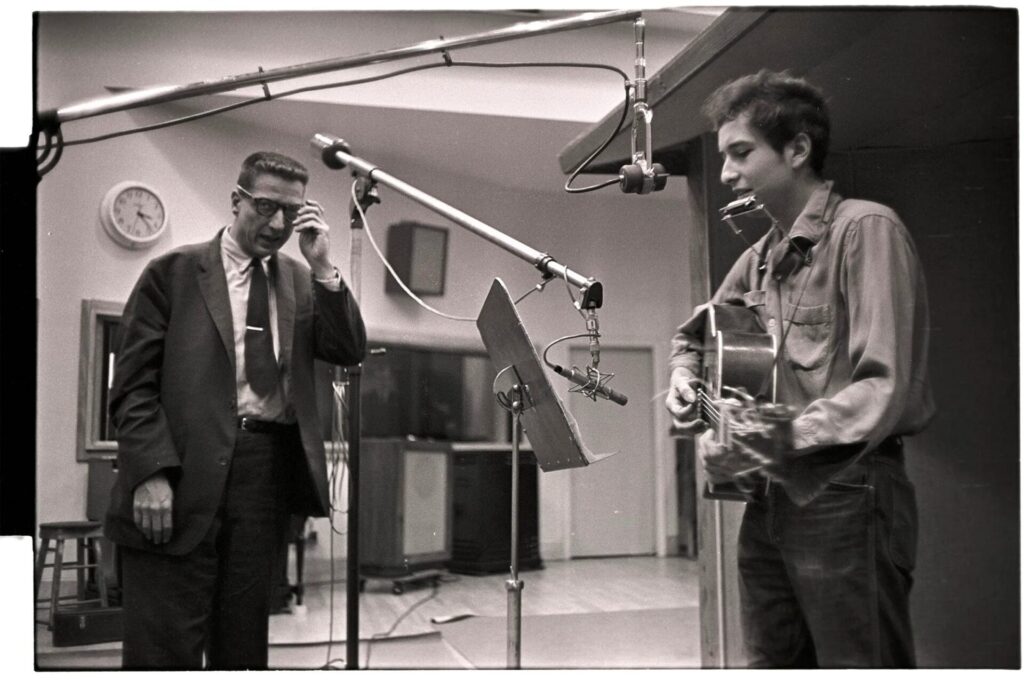
Dylan’s studio sessions during this period were often chaotic, but that chaos was productive. Musicians were pushed to respond instinctively rather than follow instructions. Producers learned to document moments rather than control them. The result was a body of work that feels alive, unstable, and fiercely present.
Songs like “Ballad of a Thin Man” benefit from this tension. The studio performance is unsettling, driven by a sense of confrontation that feels almost theatrical. Dylan’s lyrics describe alienation and misunderstanding, and the recording mirrors that mood through stark instrumentation and an unforgiving vocal take. The studio does not resolve the discomfort. It preserves it.
Blonde on Blonde and the Density of Expression
With Blonde on Blonde, Dylan pushed the studio to its limits. The album’s songs are dense with imagery, emotion, and shifting perspectives. Recording sessions stretched late into the night, producing takes that felt simultaneously exhausted and inspired.
“Visions of Johanna” exemplifies how the studio became a space for sustained poetic immersion. The song unfolds slowly, allowing each image to linger. Dylan’s vocal delivery is restrained, almost conversational, while the band maintains a subtle, hypnotic groove. The recording does not rush toward resolution. It trusts the listener to live inside the song’s ambiguity. This patience would become a hallmark of modern, album-oriented songwriting.
Reinvention Through Restraint
After the intensity of the electric years, Dylan once again reshaped his relationship with the studio. Albums like John Wesley Harding demonstrated that poetic depth did not require maximalism. Silence and space became as important as sound.
“All Along the Watchtower” reveals how minimalism could sharpen meaning. The studio recording is sparse, allowing the lyrics to dominate. The song’s circular structure and cryptic dialogue feel timeless, almost mythic. By stripping away excess, Dylan showed that modern songwriting could draw power from what was left unsaid.
Confession Without Explanation
The studio took on a more introspective role during the recording of Blood on the Tracks. While often interpreted as autobiographical, the album resists straightforward confession. The studio captures emotional truth without offering narrative clarity.
In “Tangled Up in Blue”, shifting perspectives and temporal jumps create a sense of emotional dislocation. The recording does not attempt to stabilize the story. Instead, it leans into uncertainty, allowing the song to exist as a series of emotional moments rather than a linear account. This approach influenced generations of songwriters who embraced fragmentation as a form of honesty.
Aging, Texture, and the Poetry of Time
As Dylan’s voice aged, the studio adapted rather than corrected. Later recordings embraced wear and imperfection, allowing time itself to become part of the music. This acceptance marked another evolution in songwriting, where experience replaced immediacy as a source of authority.
On “Not Dark Yet”, the studio creates an atmosphere heavy with reflection. Dylan’s voice is rough, but expressive, carrying weight that a cleaner sound would erase. The recording does not sentimentalize aging. It documents it. In doing so, it affirms that poetry does not belong to youth alone.
The Studio as Witness to Transformation
Across decades, Dylan’s studio recordings reveal an artist unwilling to separate language from sound. Each era shows a songwriter redefining what a song could contain and how it could communicate. The studio did not tame his ideas. It recorded their friction with reality.
Modern songwriting, with its acceptance of ambiguity, emotional contradiction, and literary ambition, owes much to these moments caught on tape. Dylan proved that songs could ask questions without answers, tell stories without conclusions, and sound beautiful without being polite.
The Lasting Impact of Where Poetry Met Sound
The lasting impact of where poetry met sound in Bob Dylan’s studio work cannot be measured only by chart positions, awards, or the number of artists who cite him as an influence. Its true significance lies in how fundamentally it altered the expectations placed on songs themselves. After Dylan, lyrics were no longer required to explain themselves, melodies were no longer obligated to comfort, and voices were no longer judged solely on beauty. The studio recordings preserved a new idea: that a song could function like a poem in motion, revealing meaning gradually, imperfectly, and differently to each listener.
Dylan’s recordings taught future songwriters that ambiguity was not a weakness but a strength. By allowing unresolved images and emotional contradictions to remain intact on tape, he legitimized confusion as an artistic state. Songs such as “Desolation Row” or “Visions of Johanna” do not guide the listener toward a conclusion. Instead, they invite repeated engagement, much like literature, where understanding deepens over time rather than arriving all at once. The studio, by capturing these performances without forcing clarity, helped normalize depth and difficulty in popular music.